Huawei closed 2025 with a familiar paradox: record spending on research and a modest rise in revenue. The company poured a record CNY192.3 billion — roughly 21.8% of sales — into R&D, even as headline growth slowed to just 2.2% year‑on‑year and cloud revenue to external customers actually fell.
Heavy investment, light lift
The numbers are blunt. Consolidated revenue reached CNY880.9 billion in 2025, up 2.2%, while net profit sat around CNY68 billion. Huawei’s ICT infrastructure arm — the business that houses its homegrown Ascend AI chips and large computing deployments — posted only 2.6% growth (CNY375.0 billion). More striking: cloud revenue from external customers dropped about 3.5% to CNY32.16 billion, even though Huawei reports a larger cloud total of roughly CNY72.1 billion when internal sales are included.
That gap underlines a tension in Huawei’s strategy. The company has doubled down on building an indigenous AI and compute stack — hardware like the Ascend chips and deployments such as the 384‑NPU SuperPoD and CloudMatrix AI Infra, plus services like its AI Cluster Service (AICS). But those investments have not yet translated into the kind of rapid, double‑digit cloud growth seen at some other Chinese players.
Chips, sanctions and a crowded market
Part of the story is geopolitical. U.S. curbs on access to the most advanced Nvidia accelerators have pushed Chinese cloud and AI vendors to accelerate domestic chip programs. Huawei has answered with Ascend and broader software toolchains (Kunpeng, CANN and related toolkits), and it points to growing developer traction and patents as proof of long‑term competitiveness.
Still, in the near term, U.S. tools and chips remain widely seen as market leaders for many generative AI workloads. That has helped rivals — both established cloud providers and fast‑moving entrants — expand quickly, leaving Huawei to fight both a technology catch‑up battle and a fierce domestic competition for cloud customers.
Phones cooled, cars warmed
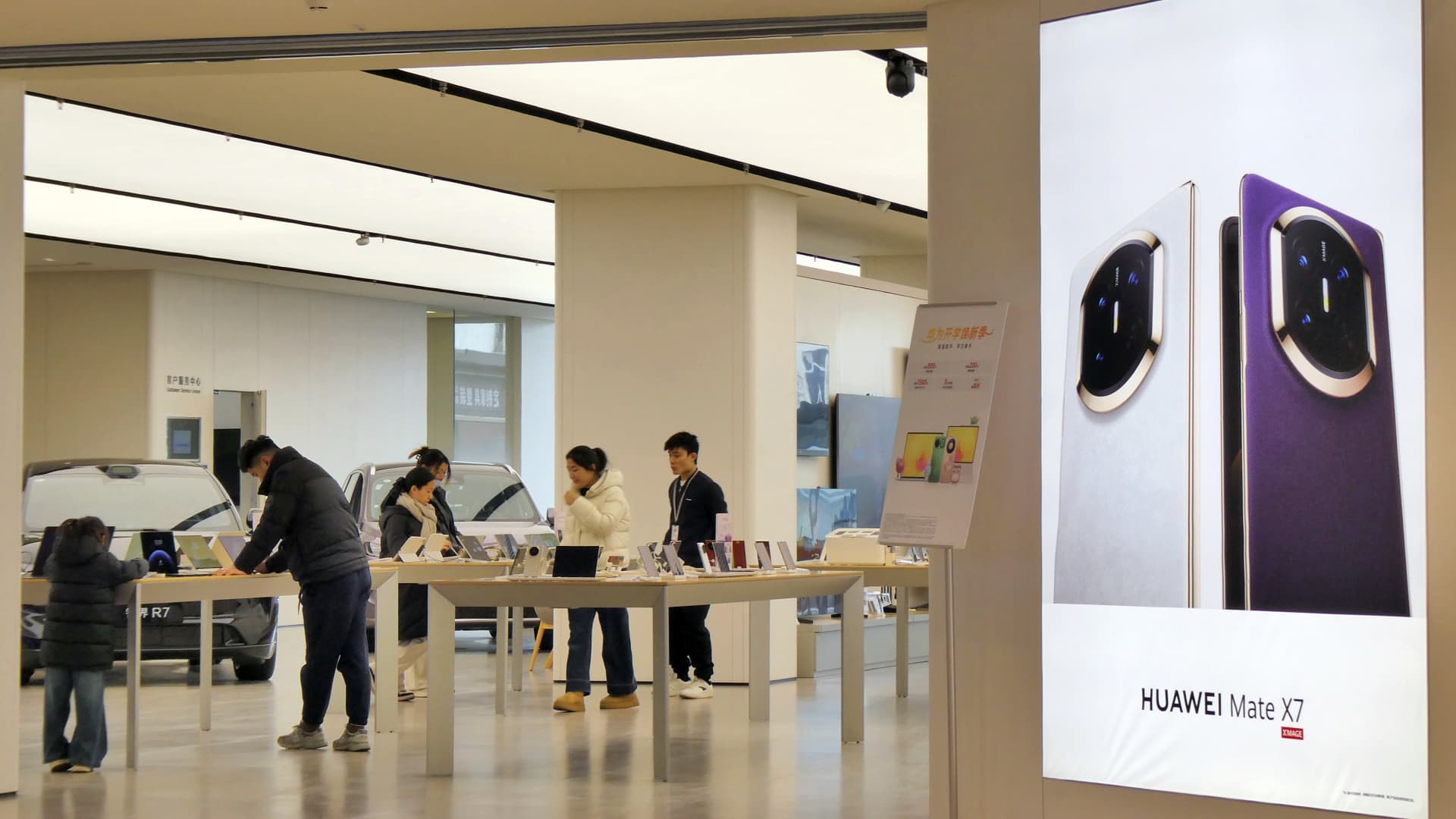
Huawei’s consumer business — smartphones and related devices — eked out only 1.6% revenue growth to CNY344.5 billion. The company remains a top smartphone shipper in China, but it ceded late‑cycle momentum to Apple after the newer iPhone refreshes, a trend visible across the market as premium device cycles re‑accelerate. Apple’s product cadence (and forthcoming foldable/flagship cycles) has shifted some demand dynamics for premium buyers—an environment Huawei must navigate while it rebuilds supply and software ecosystems. See more on Apple’s timeline for foldables and upcoming flagship leaks in our coverage of the iPhone Fold’s shipment timing and recent iPhone 18 leaks.
If phones cooled, the intelligent automotive solutions business did not. That unit surged 72.1% to CNY45.0 billion in 2025, driven by in‑car software, driver assistance platforms and components shipped into partner vehicles. Huawei calls out millions of intelligent automotive components shipped and an expanding partner network — and that growth helped lift overall profits even as other segments softened. The auto push also echoes broader industry shifts; as software and connectivity move into cars, the business model and margin profile look quite different from smartphones. For context on how software is reshaping automotive platforms, see our piece on Android Automotive’s broader changes.
What the report signals about Huawei’s path
Huawei’s annual report reads like a company positioning for a long race rather than a sprint. It boasts scale — 34 cloud regions, 101 availability zones, tens of millions of endpoints on HarmonyOS, and hundreds of billions invested in R&D over the past decade — and it leans into openness: developer toolkits, partner ecosystems and industry‑focused AI deployments.
But the near term shows trade‑offs. Heavy R&D and a domestic push for chip independence are strategic wins if they translate into software ecosystems and repeatable commercial demand. For now, they’re expensive insurance: necessary, expensive, and slow to pay back. Meanwhile, competitive smartphone cycles (and Apple’s late 2025 momentum) trimmed consumer growth, and global cloud peers expanded faster in a hot market.
Huawei’s story into 2026 will be about execution: converting chip and software investments into cloud customers beyond internal deployments, sustaining momentum in automotive and digital power, and keeping consumer devices attractive in a premium market that remains intensely competitive.
There’s patience baked into the math — and a lot riding on whether the company’s massive R&D outlay becomes a multiplier or just a cost base that keeps growth muted for another year.