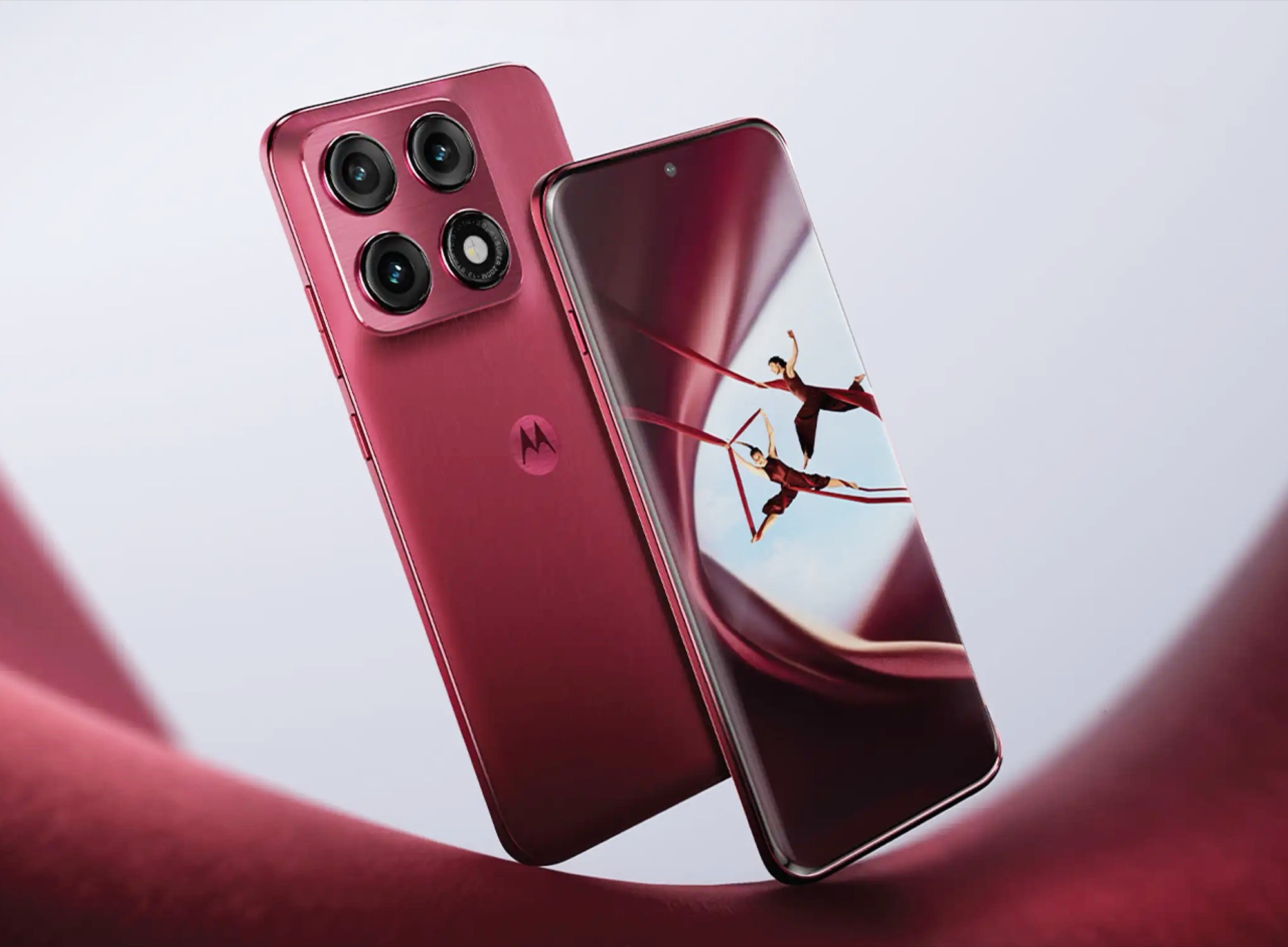
Motorola just made a surprisingly unusual move for its Edge line in the US and Canada: it went smaller.
The new Motorola Edge (2026) drops the screen size to 6.3 inches, a clear break from the bigger 6.6- and 6.7-inch displays Motorola used on recent US models. It’s also arriving with a price tag that won’t exactly make budget shoppers smile: $600 unlocked when sales begin June 11 through Motorola and Best Buy, with carrier availability following at launch or shortly after in both the US and Canada.
That smaller footprint seems to be the whole point. Motorola is pitching the Edge as a light, easy-to-carry phone in a market that keeps drifting toward ever-larger slabs. At around 160 grams, it lands in the same conversation as other ultra-thin, ultra-light phones — a space that Motorola itself has been leaning into with the Razr 2026 family and that other brands have started treating as a premium design feature rather than a compromise.
A compact phone with real camera hardware
The part that makes the Edge (2026) stand out isn’t just the size. Motorola squeezed in a proper triple rear camera setup, and that’s still not all that common in phones trying to stay this light. The main camera uses a 50-megapixel sensor with optical image stabilization and 4K video recording. It’s joined by a 50-megapixel ultrawide camera with a 122-degree field of view and macro support, plus a 10-megapixel telephoto camera with 3x optical zoom.
Up front, the selfie camera is also 50 megapixels. That’s a lot of pixels for a phone sitting in this price bracket, even if the telephoto sensor itself is modest by 2026 standards. Some buyers may notice that Motorola didn’t take the obvious upgrade path here, especially since the zoom camera still uses a 10-megapixel sensor.
The display is a 6.3-inch Extreme OLED panel with 1.5K resolution, a 120Hz refresh rate and a very bright claimed peak of 5,200 nits. On paper, that’s the kind of panel spec sheet Motorola usually reserves for phones aiming to punch above their weight.
The trade-offs are harder to ignore
Then comes the part that makes the pricing feel a little awkward. The Edge (2026) ships with a MediaTek Dimensity 7450, 8GB of LPDDR5X RAM and only 128GB of storage. That storage figure is the sting. Last year’s model offered 256GB, and if you shoot a lot of photos or 4K clips, you’ll probably feel that reduction fast.
That’s why the phone reads a bit like shrinkflation in smartphone form: the body gets slimmer and lighter, but the storage gets cut in half while the price rises. CNET noted that it weighs less than Apple’s iPhone Air and Samsung’s Galaxy S25 Edge, which helps explain Motorola’s pitch here, but the value equation is still tricky when similarly priced phones often start at 256GB.
Motorola is trying to soften that by pointing to its RAM Boost feature, which can temporarily use storage as virtual memory, and by promising three Android OS upgrades. For Motorola, that’s a solid commitment. It also includes Smart Connect, the company’s ecosystem tool for sharing files and app continuity across devices.
If this all sounds familiar, that’s because Motorola has been tightening its midrange strategy in a few directions at once. The company’s Moto G lineup has also seen some sharply different pricing and spec decisions, so the Edge (2026) isn’t an isolated case — it’s part of a broader recalibration.
Battery, build and charging
Motorola says the Edge (2026) has a 5,000mAh battery, 60W wired charging and 15W wireless charging. The company claims you can get an all-day charge in about seven minutes over cable, while wireless charging takes about 34 minutes for the same promise.
It’s also built to take a beating. The front is protected by Gorilla Glass 7i, and the phone is rated IP68 and IP69 for dust and water resistance. Motorola says it has doubled the drop and scratch resistance versus its predecessor, which matters when a phone is designed to feel as light as this one.
The body itself is just 7.22mm thick, making it noticeably thicker than phones like the Motorola Edge 70 and iPhone Air, but still very slim by mainstream standards.
Motorola also launched new earbuds
Alongside the phone, Motorola unveiled the Moto Buds 2, a $100 pair of wireless earbuds that should arrive in the US on July 2 in Pantone Carbon. They use a dual-driver setup with 11mm dynamic and 6mm micro planar drivers, support Bluetooth 6.0 dual connection, include a gaming mode for lower latency and offer up to 55dB of active noise cancellation.
Battery life is respectable too: Motorola claims 11 hours on the buds themselves and up to 48 hours with the case, with a 10-minute top-up delivering around three hours of playback.
The launch fits neatly into Motorola’s broader 2026 playbook: slimmer hardware, more attention to design, and a willingness to make some sharp compromises to get there. The Edge (2026) is light, nicely equipped on paper and unusually compact for its class. It’s also expensive enough, and storage-limited enough, that shoppers may need to decide whether they want a petite phone with premium camera hardware — or a bigger device that feels less cramped after a year of photos, videos and apps.