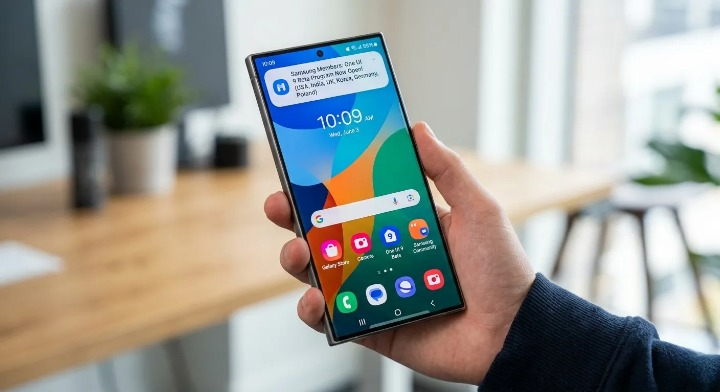
Samsung’s next software jump is starting to look less like a beta test and more like a full-scale deployment plan.
Over the past few days, internal One UI 9 builds have surfaced for a surprisingly wide spread of Galaxy hardware: the Galaxy S23 series, Galaxy S24 series, Galaxy S24 FE, Galaxy A56, and even the Galaxy Z Fold7. That sits on top of the Galaxy S26 family, which is already running beta 3, while the Galaxy S25 line appears to be next in line for public testing.
The pace is notable. Samsung is no longer poking at One UI 9 on a single flagship tier and then moving on. It’s now developing the Android 17-based software across multiple generations of flagships, a midrange phone, and the newest foldables at the same time. That usually means one thing: Samsung wants this release ready much earlier than it managed in past cycles.
For Galaxy owners, the promise is simple enough. If your device is eligible, One UI 9 is a free upgrade. The reality, though, is that the update path depends on where Samsung draws the line for each family. Newer devices like the Galaxy S24 series and Galaxy S25 line are being positioned for the next phase of the rollout, while older models are still getting attention in internal testing but may not all land the same feature set.
The beta itself is still focused more on polish than flashy surprises. Samsung’s current S26 beta has already addressed things like camera preview cropping, lock screen widget bugs, S Pen swipe glitches and random reboots during video streaming. It also introduced a Summarize Notifications shortcut in Quick Panel, with Samsung clearly labeling the summaries as AI-generated. That kind of transparency matters, especially as phones lean harder into on-device and cloud-assisted AI.
The bigger headline feature, though, is Gemini Intelligence, Samsung’s answer to the new wave of agentic AI. It’s not widely visible in the current beta yet, but it’s expected to arrive with the Galaxy Z Fold8 launch in July. In practical terms, that means the software should be able to handle multi-step tasks with less hand-holding — things like scanning your notes, dropping items into a shopping cart, drafting email replies, or juggling a few steps of a booking process without constantly asking you what to do next. It’s ambitious, and it also opens the door to fresh security questions, which Samsung will have to answer quickly if it wants users to trust the feature.
The rollout pattern also lines up with Samsung’s hardware roadmap. The company’s next foldables — expected to include the Galaxy Z Flip8, Galaxy Z Fold8 and Galaxy Z Fold8 Ultra at its July 22 event in London — are widely expected to ship with stable One UI 9 out of the box. That would make the new folding phones the first devices to launch with the update fully baked in, rather than receiving it later as an over-the-air upgrade.
There’s another layer here worth watching: Samsung appears to be testing One UI 9 across more of its lineup than usual, from premium devices down to the Galaxy A56 and entry-level 5G models mentioned in firmware tracker reports. That kind of breadth suggests the software team is trying to avoid the staggered, fragmented rollouts that have plagued Android releases for years. If it works, Samsung could end up with one of the smoothest transition windows it has managed in a while.
That doesn’t mean every Galaxy owner is headed for the same future, though. Separate reporting suggests Samsung’s software support policies are already drawing hard boundaries for some older models, with devices like the Galaxy S23 series likely reaching the end of their major feature-update run after One UI 9. If that sounds familiar, it’s because Samsung’s newer update policy only applies to newer generations; older phones don’t get retroactive promises. Samsung’s software cleanup) is becoming a little more ruthless as the company moves deeper into its longer support era.
And that’s where the tension sits. Samsung is moving faster, testing more broadly and pushing AI deeper into its software. At the same time, it’s also sorting devices into clearer winners and finish lines. Some phones will get the full One UI 9 experience and likely beyond. Others may receive one last major leap before settling into security updates only.
If you own a supported Galaxy, the update path is easy to check: Settings > Software Update > Download and Install. For everyone else, the internal build leaks are still useful because they show where Samsung is putting its energy — and right now, that energy is spread across the S26, S25, S24, S23, the A56 and a new generation of foldables that look set to define the company’s software story for the rest of the year.
Samsung’s broader strategy is becoming clearer with each leak. The company wants One UI to feel less like a skin and more like a platform, which is why it’s also working on better privacy signaling, refined blur effects and a more polished interface overall. Some of those changes have surfaced in One UI 8.5 beta work and in Samsung’s push to add more cross-device convenience to Galaxy software. One UI 9 looks like the next, much bigger step in that same direction.