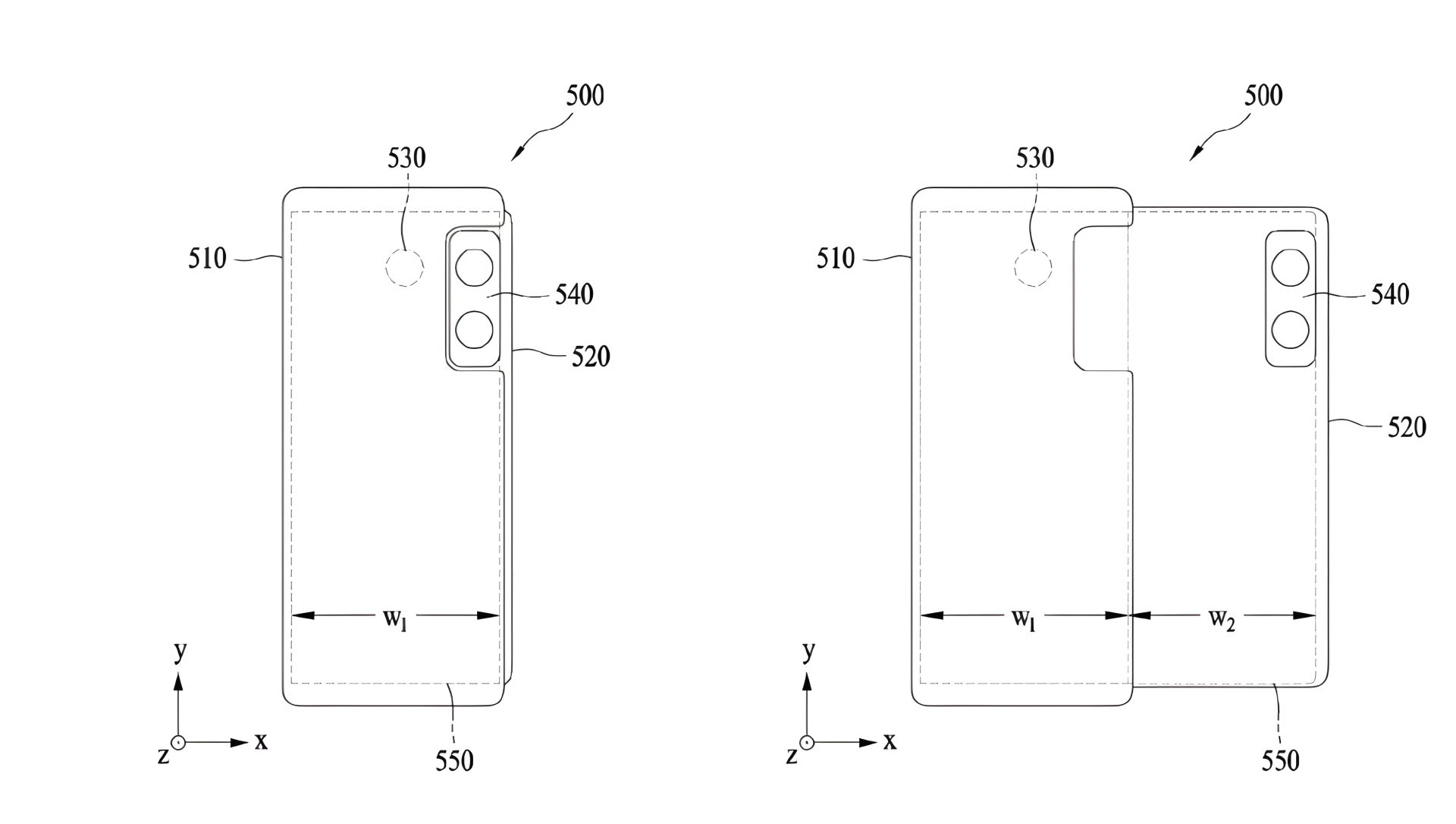
Imagine a phone that literally drags its camera along as the screen grows. That’s the image Samsung’s latest patent sketches — a rollable or sliding handset whose rear camera module rides the expanding display instead of staying fixed on the chassis.
The patent, surfaced by sleuths on social platforms and picked up by tech trackers, lays out a device that looks like a conventional bar phone when the AMOLED is tucked inside its body. Pull the display out and the phone broadens into a larger, almost Fold-like canvas — but crucially, the camera array moves with that stretching section and nests into a cutout on the rear panel when fully extended.
A camera that keeps up
The drawings show a vertically oriented camera block placed on the portion of the device that extends. When the screen is retracted, the module sits inside a frame cutout; when the screen is unrolled, the camera slides into position alongside the larger display. The patent also mentions sensors that would track display size and detect shifts in antenna and camera positions as the phone morphs.
That design choice isn’t purely for show. Notebookcheck notes that putting the camera on the sliding section could let Samsung shave thickness from the device’s main body: the camera hardware wouldn’t need to sit on top of the rollable panel or force a thicker stationary spine. In practice, a slidable camera carriage could mean a sleeker profile when the device is closed, but a bulkier moving section when open — trade-offs Samsung would have to balance.
What the sketches tell us (and what they don’t)
Patent art is intentionally schematic, and Samsung’s is no exception. The illustrations hint at a punch‑hole selfie camera, a triple rear camera stack, and an outward-rolling display that broadens to tablet-like real estate. Notebookcheck and other observers point out the patent was published in May 2026 but was originally filed in mid-2023 — a reminder that these ideas can simmer in R&D for years before anything concrete reaches shelves.
Previous Samsung experiments make the concept feel less hypothetical. The company showed a rollable OLED prototype in 2023 and demoed a Slidable Flex Duet-type panel that can expand from a phone-size footprint toward tablet dimensions. Samsung has also filed other patents for hybrids that both roll and fold. Even so, an earlier device can’t guarantee a consumer product: patents are as much about staking technical territory as they are about shipping phones.
A short chronology of rollables and sliding experiments
Rollable ambitions have popped up across the industry — from LG’s lost rollable prototype to Motorola’s concept experiments — and Samsung isn’t the only company exploring ways to change screen area on demand. If you want a deep look at the LG prototype that taught engineers a lot about the limits and possibilities of the format, see the teardown examination of the LG Rollable (/news/lg-rollable-teardown-inside).
Closer to Samsung’s current flagships: when closed this new patent’s silhouette reportedly resembles a Galaxy S26 Ultra — a compact bar-style phone — and when open it’s said to approach the feel of a Galaxy Z Fold7. Samsung’s work on in-screen sensing and other display innovations (like the privacy-focused tweaks on the Galaxy S26 Ultra) shows the company is still pushing display tech on multiple fronts; those experiments may feed into any future rollable projects [/news/galaxy-s26-ultra-privacy-display].
Practical questions (and engineering headaches)
Moving hardware on a phone raises a stack of practical concerns.
- Mechanical reliability: sliding and rolling mechanisms add moving parts that must survive thousands of cycles, drops, dust and spills.
- Wiring and antennas: if the camera shifts position, flex cables and antenna tuning must accommodate the movement without signal loss or breakage.
- Thickness vs. ergonomics: placing heavy camera hardware on the moving portion may make the extended phone feel unbalanced or thick where you least want it.
- Software calibration: sensors that detect the panel’s state would need to tell cameras, radios and UI elements exactly where components sit so autofocus, connectivity and user prompts remain accurate.
Those are hardly showstoppers, but they’re engineering headaches that explain why rollables still feel experimental. Samsung’s patent explicitly references sensors to track many of these changes — a sign the company is thinking about the systems-level work this design would demand.
A patent, not a promise
Patents are a peek into a company’s imagination, not a product road map. The filing joins a growing pile of concepts — some will inform future phones, others will quietly fade. Still, Samsung’s continued public demos of rollable panels and advanced OLED sensors suggest the company is intent on keeping options open. Whether the mobile industry wants yet another form factor or whether consumers prefer incremental improvements to durability and camera performance remains an open question.
For now, the sketch of a camera that moves with the screen is an intriguing engineering solution: clever, a bit unsettling, and very much in keeping with the modern smartphone’s push for new ways to stretch flat glass into something more flexible. Samsung’s patent leaves room for creativity — and for plenty of practical work before such a phone could land in your pocket.