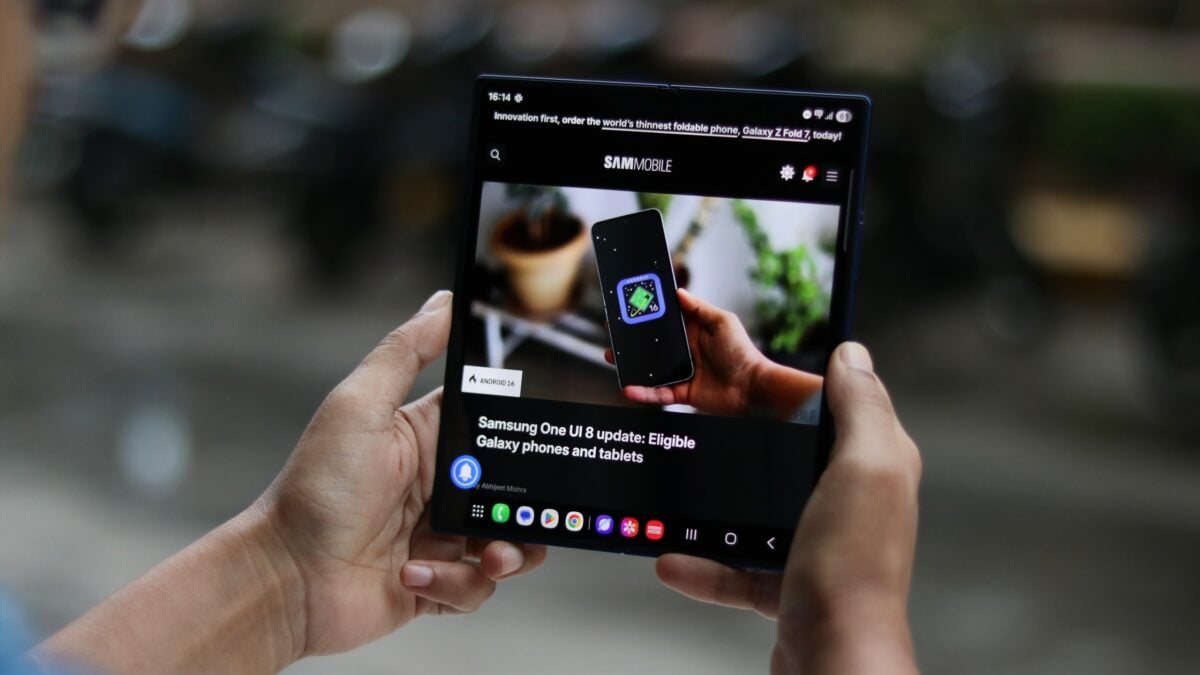
Seven years after Samsung first introduced the Fold, the line’s most nagging flaw — that obvious, tactile crease — might be about to disappear.
A respected tipster says the latest test units of the upcoming Galaxy Z Fold 8 series show a “significant” crease improvement that’s on par with the Oppo Find N6, the current industry benchmark for a near-invisible, “zero-feel” fold. That’s notable because Oppo’s approach pairs a specialized hinge with display engineering to make the fold almost imperceptible; if Samsung has replicated that, it’s a major engineering win for a company that’s iterated on foldables generation after generation.
Which models get it (and what they’ll be called)
Leaks and reporting converge on two models: one a taller, narrower successor to the Fold 7 that will carry the Galaxy Z Fold 8 Ultra name, and another — the wider, shorter device that surfaced in multiple hands-on leaks — now expected to be marketed simply as the Galaxy Z Fold 8. In other words, the “Wide” variant keeps the standard name while the model that looks like the classic Fold inherits the Ultra badge.
The naming shuffle matters beyond labels. Early rumors indicate the wider Fold 8 could drop one rear camera compared with its sibling, trading some photographic versatility for a more tablet-like screen. The Fold 8 Ultra, meanwhile, is rumored to be the more battery-heavy device — one leak points to a 5,000 mAh cell with 45W wired charging and a 50 MP ultrawide camera — but without some of the Galaxy S-series hallmarks like S Pen support or Samsung’s Privacy Display.
That absence is worth flagging because Samsung’s S-series has been using features such as the Privacy Display to distinguish Ultra models; it’s why some observers warn that “Ultra” risks meaning less if those signature extras aren’t carried over. For context on how Samsung has used privacy tech on flagship hardware, see the Galaxy S26 Ultra’s approach to a privacy display and its trade-offs Samsung’s Galaxy S26 Ultra puts a privacy screen under your thumb — with trade-offs.
A back-and-forth on the crease
The chatter hasn’t been tidy. Early posts from the same tipster noted prototypes that didn’t improve the crease much — but that clarification applied to earlier, non-final test units. The newer claim refers to the latest iterations in Samsung’s testing pipeline, which reportedly deliver a crease “just as impressive” as Oppo’s. Manufacturing at scale is a different beast, but the improvement in test units is still meaningful: the crease has been a stubborn mechanical and materials problem since foldables arrived, and any step toward “zero-feel” will be eagerly noticed by reviewers and buyers.
Why should consumers care? Because the crease isn’t just aesthetic. It affects touch interactions, on-screen content, and the overall sense of a device feeling like a single, continuous display. A better crease would help foldables finally feel less like a compromise and more like a mainstream, premium category.
Timing and competition
Samsung is expected to unveil the new Fold duo at its Unpacked event on July 22. That puts the company in a race with other players: Oppo’s recent Find N6 set the baseline for crease reduction, and Apple’s long-rumored foldable — widely reported as an iPhone Ultra-style device — remains a looming rival; Apple’s rollout has its own timeline questions, and those dynamics ripple into how consumers and carriers view foldables broadly. For Apple’s shipping speculation and timing, there’s useful reading on the iPhone Fold’s likely schedule Apple’s iPhone Fold: Likely Announced in September, but Shipments Could Slip into Year’s End.
Samsung has also been experimenting with different foldable formats beyond the two Folds, reviving and retiring designs as it tests demand — notably the company’s tri-fold experiments that have surfaced and retreated in recent months. Those broader gambits underscore that Samsung is still treating form-factor experimentation as an iterative process rather than a finished strategy Samsung Pulls the Plug on the Galaxy Z TriFold After Three Months.
Trade-offs and expectations
This generation’s rumor sheet reads like a list of compromises aspiring to balance: a wider screen that may cost a camera, an Ultra badge that might not bring the full suite of S-series bells, strong battery claims but uncertain accessory support. And then there’s price. Samsung raised prices on its flagships recently, and component cost pressures — plus the engineering needed for an improved crease — make a price uptick plausible.
If Samsung truly achieves a near-crease-free display across both Fold 8 models, the practical effect could be subtle but powerful. It would blunt a longstanding criticism, make the devices more comfortable for everyday use, and push competitors to close the gap. If the improvements remain confined to engineering samples or come at the cost of other sought-after features, then buyers will have to judge whether a smoother seam is worth the trade-offs.
Either way, July’s Unpacked should be livelier than usual for foldable watchers. Expect a lot of close-up footage, hinge talk, and — inevitably — hands-on impressions that live or die by whether the crease really has vanished.