Samsung is giving Health its biggest overhaul in years, and this one is less about stacking up more numbers than about telling you what those numbers actually mean.
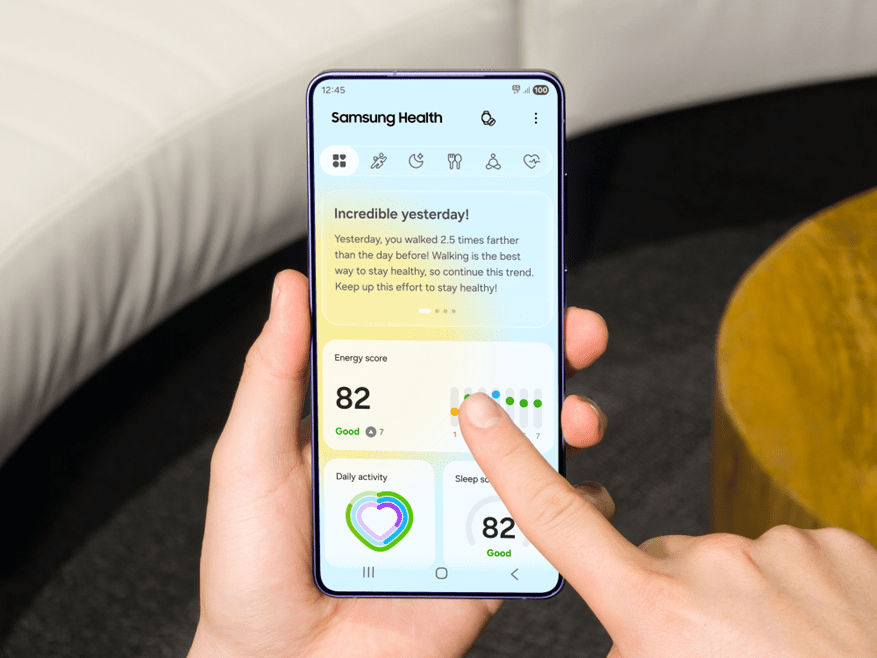
Starting June 8, the Samsung Health app will begin rolling out a redesigned experience that lays the groundwork for the next Galaxy Watch. The company is turning the app into a more proactive coach, with AI-driven guidance, a cleaner home screen, and a handful of new health metrics aimed at cutting through the usual smartwatch noise.
The timing is no accident. Samsung is using the app update as a preview of what its next watch can do, and the new features are clearly designed to make the platform feel more helpful in everyday use. Instead of making users hunt through a dense dashboard, Samsung Health now organizes the home screen around five pillars: Sleep, Activity, Nutrition, Mindfulness and Vitals. That last one is new, and it sits at the center of the refresh.
Vitals takes five overnight readings — heart rate, heart rate variability, respiratory rate, skin temperature and blood oxygen — and compares them against a user’s resting baseline. The idea is simple: only flag something when the data actually looks meaningful. In other words, fewer nagging alerts, more useful nudges. If your body is drifting away from its normal pattern, Samsung wants the watch to say so in plain language, not bury the point in a chart.
That same philosophy runs through the rest of the update. Heart Health Score folds together sleep, stress, activity and body composition into a single daily metric, replacing Samsung’s older Vascular Load approach. Daily Cardio Load watches how much strain your cardiovascular system is under during aerobic exercise and suggests training targets and recovery time, so users can push hard without accidentally cooking themselves. Fitness Index, meanwhile, compares heart rate, VO2 max and step data to help tailor goals based on your strengths and weak spots.
Samsung’s own wording makes it clear this is a shift from passive tracking to something more interpretive. Hon Pak, Samsung’s senior vice president and head of digital health, said the company wants to connect data from Galaxy Watch with AI-based insights so people can understand their physical and mental condition more easily and intuitively. That’s the pitch, at least: less spreadsheet, more coach.
The app is also getting some meaningful upgrades to features that already existed. Antioxidant Index now comes with trend charts and daily history logs, which should make it easier to connect dietary choices with longer-term patterns. AGEs Index is moving further into the background, collecting overnight measurements automatically to help build a picture of how lifestyle habits accumulate over time. It’s a quiet addition, but one that fits Samsung’s broader push toward invisible, always-on health tracking.
Then there’s Hearing Health, a new feature that leans on the broader Galaxy ecosystem. By using the Galaxy Watch, phone and buds to monitor ambient noise, Samsung can warn users if they’re spending too much time around loud environments. It’s the sort of feature that sounds minor until you think about how much damage builds up slowly — on commutes, at concerts, or with music turned up too high. Samsung says the goal is to help protect hearing before the problem becomes obvious.
This move also sharpens Samsung’s competition with Apple, which has spent years turning the Apple Watch into a serious health platform. Samsung’s hardware has long been capable, but the software story has often felt one step less polished. That gap is exactly what this update tries to close. It’s similar to the broader direction we’ve seen across mobile software lately: less raw data, more interpretation. Apple’s own wearable playbook has pushed the market that way, and Samsung clearly isn’t interested in being the company that only counts steps.
There’s a nice parallel here with other recent platform moves, including Google’s ongoing work to make Android features feel more predictive and less manual. Samsung, though, is going all-in on the health side of the equation, and it’s doing so with the kind of ecosystem integration that could make the whole thing more useful than a standalone watch app.
The June 8 rollout will show off the software side first, while the fuller hardware experience lands with the next Galaxy Watch. Samsung hasn’t disclosed every detail yet, but the company has made one thing obvious: this generation of Galaxy Watch is being pitched less as a passive tracker and more as an always-on health partner that speaks human, not telemetry.