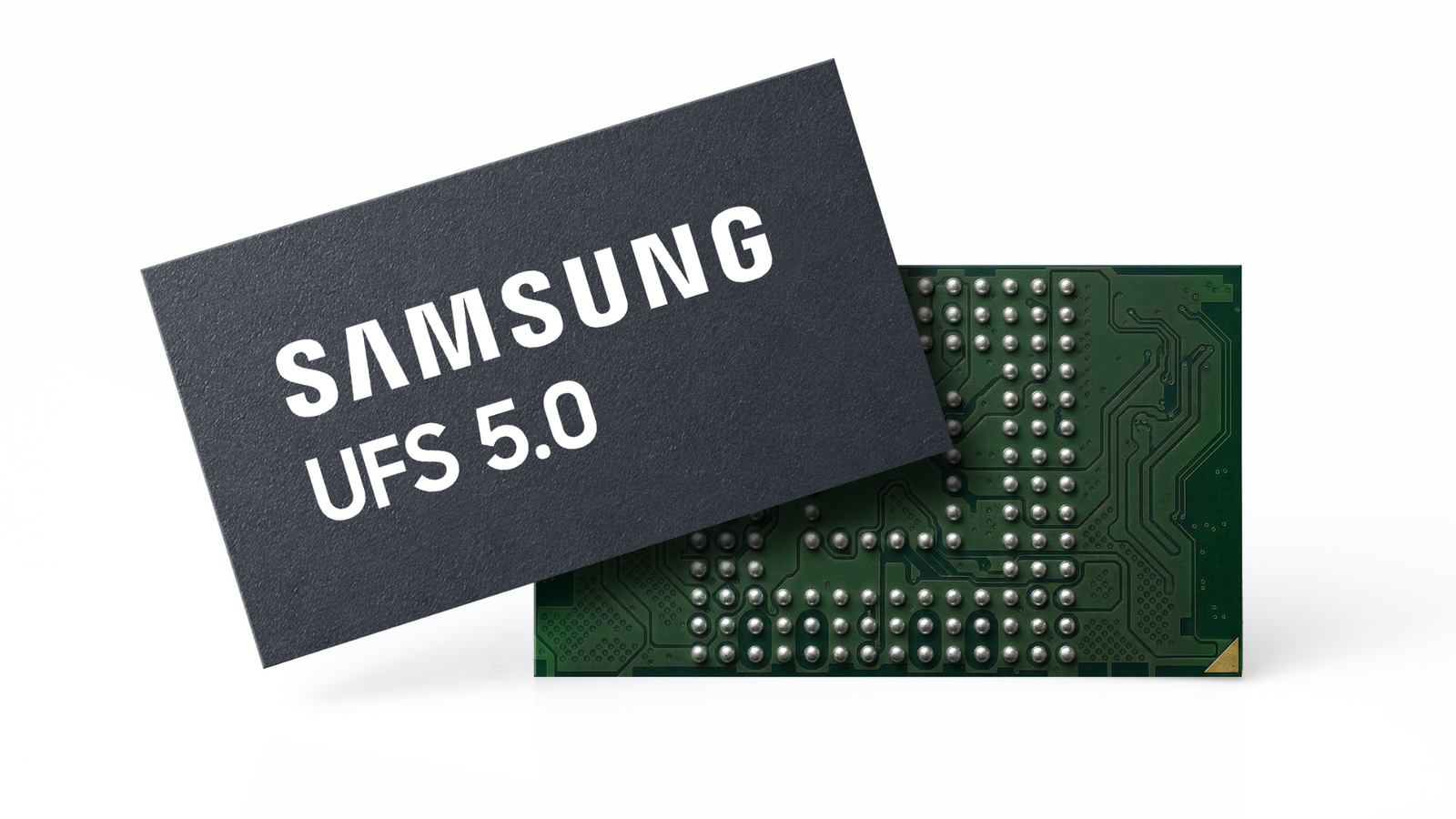
Samsung has pulled the covers off its first UFS 5.0 storage solution, and the headline numbers are exactly the kind of spec-sheet flex you’d expect from a company aiming at next-generation flagship phones: up to 10.8GB/s read speeds and 9.5GB/s writes.
That’s a huge jump over the UFS 4.1 parts now shipping in the fastest phones. In practical terms, Samsung is talking about roughly twice the throughput, along with better power efficiency and a smaller chip package. The company says UFS 5.0 cuts power use by more than 40% compared with UFS 4.1, while shrinking the footprint by 16.7%.
Those two details matter almost as much as the raw speed. Phone makers are always fighting for space inside increasingly crowded devices, and every millimeter reclaimed can go toward a larger battery, better cooling, or more ambitious camera hardware. Samsung is also framing the launch around on-device AI, where faster storage can reduce the lag between a request and a response when a phone is processing large data sets locally.
Why the storage upgrade matters
Storage speed rarely gets the same attention as a new camera sensor or a shiny display, but it can shape the feel of a phone in ways people notice immediately. Faster reads can shorten app launches, speed up loading in heavy games, and make big files move around without the annoying little pauses that remind you a phone is still just a tiny computer.
The AI angle is even more important. A lot of the clever stuff phone makers are pitching now — image generation, document summaries, photo sorting, assistant-style features — still leans on the cloud. That means your device often has to send data away, wait for the server to do its thing, then pull the result back down. UFS 5.0 helps reduce that bottleneck, making local processing more viable and less dependent on a strong connection.
Samsung says the new storage also supports more privacy-friendly workflows, since sensitive data can stay on the device rather than bouncing to a remote server. That’s a theme the industry keeps circling back to, especially as more phones try to sell themselves as personal AI machines rather than just fast slabs of glass and aluminum. It fits neatly with the broader shift toward on-device AI features, even if Samsung is obviously pursuing that future in its own way.
The size reduction also opens the door to more creative phone design. It may not sound glamorous, but when storage gets smaller and cooler, engineers get room to make better trade-offs elsewhere. That’s the kind of change that can ripple through future devices, including wearables and XR headsets, not just phones.
Samsung says mass production of UFS 5.0 will begin in the fourth quarter of 2026, with capacities going up to 1TB. That timing makes it unlikely to show up in this year’s flagships, and even next year’s Galaxy S-series may still lean on UFS 4.1. Still, the company is clearly laying groundwork for the next wave. Rumors around a possible Galaxy S27 Pro already suggest Samsung may be preparing a more ambitious storage-and-AI story for its next generation.
Notebookcheck reports that Samsung is also working on the Exynos 2700, which could natively support UFS 5.0. If that pairing happens, the Galaxy S27 family would be a natural candidate to show off the new storage standard first. Samsung hasn’t confirmed that combination, but the timeline lines up: UFS 5.0 production in late 2026, phone launches in early 2027.
For now, this is one of those announcements that looks like infrastructure until you think through the knock-on effects. Faster storage. Better battery efficiency. More room inside the phone. Less dependence on the cloud. Suddenly it sounds less like a component spec and more like the kind of upgrade that could quietly reshape what a premium phone feels like day to day.
And if Samsung is right, the next flagship you buy may not just be faster on paper — it may feel snappier in the weird, hard-to-describe ways that actually matter once you’ve lived with it.